Tony tebbe’s PREDATOR UNIVERSITY | Guided predator hunts and predator calling school in New Mexico and texas.





About Decoy Dogs with Tony Tebbe submitted on March,22 2010 by Tim Morehead
To say Tony Tebbe is a predator hunter would be putting it mildly. It wouldn't surprise me if he has fur running
through his veins. The consummate hunter and houndsman, Tony is the owner and operator of Predator
University where he offers guided and instructional predator hunts as well as some of the most finely crafted
predator calls available today. His ability and knowledge gained through years of experience in the field allows
him to put hundreds of predators in front of his clients each season. I recently had a chance to talk with Tony
and ask him some questions about using decoy dogs to hunt coyotes, here is his response.
What exactly is a decoy dog? What does a decoy do?
The term “decoy dog” is a widely used term. You could ask ten different dog guys and get several different
answers. What it comes down to from a hunter’s perspective is… besides being a hunting companion; a dog
is just another tool. It is not a magic talisman. As usual, being a tool, everybody uses that tool differently.
To me, from a predator calling perspective, a decoy dog is any dog that draws the coyotes attention away
from the caller to it itself [the dog] and helps the hunter put more fur on the ground. That is a very generalized
description because every hunter is different and every hunter uses their dog to compliment their style of calling.
Some callers prefer to a tolling dog. A tolling dog is a dog that goes out long distances and brings a coyote
back to the hunter. There are situations where the coyotes may be six hundred to a thousand yards out and
the hunter will cast the dog to go find the coyotes and bring them back to the gun. Other hunters may want a
dog that stays close, well within gun range, and actually bait the coyote to them.
The true essence of a decoy dog is a dog that will chase a coyote but will come back on command. Decoy
dogs absolutely must return on command, they have to “sic” when you cast them to chase game and they
must be “straight” (only chase game that you want them to chase). A common way,the one that I use, to
get a dog to return on command is by using a beeper collar. The hunter has to at all times be in control of
their dog or it can rapidly and easily turn into a miserable mess. That being said, some dogs learn through
experience as well and they know to come running back when they get their hands full. It’s a cat and mouse
game. Dogs chase coyote, dog comes running back and coyote follows on a string.
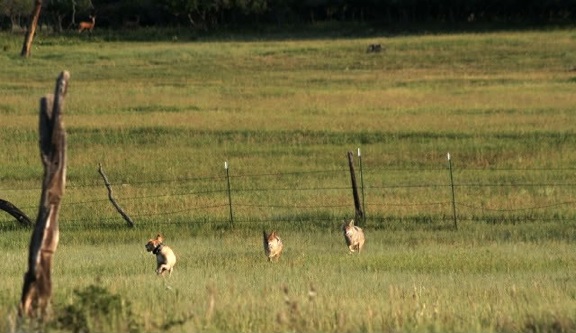
This is Lacy, the mother of my Brandy pup, tolling a pair of coyotes that were causing problems for a rancher and his dogs.
(Photo courtesy of Jason Carruth)
What was your first experience with decoy dogs?
I’ve always been into dogs, I’ve had dogs my entire life, when I was in high school I had a pack of fifteen beagles. When I was around fourteen I started calling coyotes and at sixteen I started running them with hounds. After about ten years I started crossing greyhounds and pit bulls to use a catch dogs. If you are not familiar with the term, catch dogs are dogs that you “sic” on a coyote and they go catch it. It got to the point where I was killing over a hundred coyotes a year without ever firing a gun.
I did that for about ten years or so but then with marriage and children the dogs kind of fell to the wayside for a while. But then, when I started my guiding business I knew that I wanted to use dogs again but I wanted to do it different, I wanted to mix dogs with the calling. I could be a hounds man on Saturday and a caller on Sunday but they never crossed over. What absolutely convinced me to combine the two was when I had a hunter that in two nights he killed four bobcats and injured five others that got away. That’s when I made my mind up that I have to get a dog.
A dog will pay for itself just in recovery work. I can positively say that since I have been using a dog I have never lost a wounded animal. If it has a hole in it, it will be found, period. We have killed nine or ten cats and around three hundred and fifty coyotes this season and we haven’t lost a single animal. Not all shots are perfect and having a dog to recover wounded game is a big deal especially when night calling. If for nothing other than recovery, the use of a dog is important.
Can you give me specific examples of why the use dog is so effective?
One hunt right here on one of my favorite stands on the edge of town in Lovington, New Mexico, I was calling for two clients and here comes a group of five coyotes barreling right in. They stopped at about one hundred and fifty yards out and were starting to move downwind of us. I barked, the client shot and dropped a coyote at the shot. My dog ran out grabbed the downed coyote and started shaking him. Two of the coyotes took off but two stayed and started circling, barking and howling at my dog. Those two coyotes died as well.
Another example would be a hunt in Texas where I was calling and instantly two coyote come running through the woods. The client dropped one with a shotgun and the other took off with my dog in tow. I kept calling and when it was all said and done we had seven come in, the whole pack, and we killed one more. About five minutes pass, I’m trying to get my dog back and I am starting to get a little worried about my dog because I now know there are at least five other coyotes out there with him somewhere in the woods and I can’t see them. Finally, he comes running back with four coyotes chasing him and nipping at his ass. He [my dog] runs up to the client with the shotgun and sits down right beside and another coyote gets shot at about three yards.
A third example would be a hunt I was on with buddy of mine. We were calling and had a pair of coyotes come charging in, a male and female. The female was charging hard right at us so we dropped the male which wasin the back first. Mydog takes off after the female and she runs right between us, right through our setand keeps going waybehind us. I get Gunner to come back, at the time I was using a beeper I was actually ki-yi-ing on the call. He come running back and she come following, not aggressive but just like he was leading her. He come back and stood ten or twelve yards in front of us, she worked a circle around him and when she was clear for a shot we killed her. Without the dog that coyote would have just kept on running and got out of Dodge.
When you’re a dog runner, the success of the dog is a very high priority to you. When a coyote comes in to a call and sees the dog I absolutely freeze, I just sit there and let it all play out that’s kind of the joy of having a dog. Coyotes get so focused on the dog that they want to chase it, kill it or run it off so they get to that rabbit. I have had quite a few stands where a coyote comes in and when the dog runs out to meet it the coyote will set there with hackles up working its way around the dog. Just as soon as it is around my dog it will come running right directly to me where I am sitting with my mouth call.
I don’t know if the coyotes know that it is a dog or if they think it is another coyote and I really don’t care. I do know that using dogs work to put more fur down. I have only ever had three coyotes flare, get scared and run from a dog. That’s pretty good odds.
Are the dogs ever in danger?
It depends a lot on the individual dog. A dog needs to have enough sense to know when he’s got a situation that’s a little more than he can handle and at that point the needs to come running back. You can train all you want but it comes down to the individual dog and his ability to realize when he needs to get back to safety.
Are the dogs ever in danger? Yeah, I would say so. But it’s a partnership, you are depending on the dog and the dog is dependent on you. You need tobe able to control your dog. If a dog chases a coyote across the county and runs into a pack waiting for him then yes, he’s in real danger. If a hunter maintains control of his dog I think the danger is minimal. I value my dog very much and I will kill the coyote or physically get into the mix if I have to protect my dog.
Is there a certain breed or what are the specific traits that you look for in a dog?
Generally speaking there is no specific breed. I have seen everything from Doberman Pinschers to little Wirehaired Terriers used. There are definitely certain traits that I want in a dog and I cross-breed for that. A dog has got to have hunting background and know that his lot in life is to hunt for you.
I prefer the cur breeds. I want a dog that has a head on his shoulders and definitely wants to hunt. You can start talking about personal preferences as well. I personally don’t want a big flabby hound like dog. I want a dog that is tight and fast and can get the job done. I don’t want a dog that is overly big, I like a forty to fifty pound dog that don’t take a bunch of room in your hunting rig and doesn’t have the potential to intimidate a coyote based on its size. I don’t want a Great Pyrenees but at the same time I don’t want a dog that’s too small. I want a dog that’s fast enough to get away from a coyote if he has to and but still be big enough to fight if need be.
My dog Gunner is a Black Mouth Cur and Catahoula cross which has been a very popular cross for hog dogs for many years. He has a lot of grit but for my personal taste I would like even more grit so I have already crossed him with my female pit bull. I will then cross that back with my Jagdterrier Cur cross and I think that will give me some really great dogs. With training I can always tame down a dog that has a bit too much grit but I can’t add grit to a dog that doesn’t have any.
You need a thinking dog not a dog that all he knows to do is run. A dog should add to the stand not detract from it. You want a dog that knows this is a cat and mouse game and is smart enough to play the game.
How do you train a decoy dog?
I don’t know what others do but I can tell you how I do it. I use what I have available to for training. As a pup I started Gunner out on chasing jack rabbits because that is what I have that is readily available. They have to get on some kind of game so he trained, with my greyhound, on day and night catching jack rabbits. Once he got the idea of what it is to “sic” something up, catch it, grab it, shake it, and to come back when I tell him to come back, even if it’s in the middle of a heated race, then I started working him on coyotes.
There’s a different of ways to work them on coyotes. You can catch (trap) coyotes and put them in front of the dogs or you can put a pup on an injured coyote. However you do it you need to get coyotes or some kind of game in front of your dogs. Whatever game you use to start with, the dog can always be broke from later if that is not you intended target.
Why do YOU use a decoy dog?
It puts more fur on the tailgate and I absolutely enjoy the companionship. A dog doesn’t have to schedule time off work or ask permission from the wife to go hunting. He is always ready and willing. My dog is another calling partner; he will sit on stand and pay more attention than most hunters. He will sit and watch downwind. Even if for some reason I am forced to watch upwind he will sit behind me and watch downwind because he is smart enough to know that’s where coyotes come from.
Opinions are everywhere; you know what they say about opinions. Some guys say that the only time decoy dogs are effective is during denning season. That is absolutely not true! Dogs are effective year around. I don’t care what other people might tell you. I know it for a fact. I will not do another calling stand,unless I am forced to, without a dog. I am totally sold on it, I love it. I enjoy the companionship of dogs and it adds way more coyotes. I would recommend it to anyone.
Monday, March 22, 2010